Weeding Out the Smooth Talkers: The Nurse Farmer’s Guide to Generational Trust
There is a beautiful, old poem often attributed to Mother Teresa that says, “The good you do today will be forgotten tomorrow. Do good anyway.” As a registered nurse, my critical-thinking brain always wants to add an asterisk to that advice: “Do good anyway... but protect yourself in the process.”
One trap many of us fall into—especially those of us who grew up in a generation where a handshake meant something—is assuming other people think the way we do. We assume that if we treat someone with kindness, support their business, or offer grace during their hard times, they will naturally respect that kindness.
Unfortunately, this innocent assumption can leave us vulnerable to being taken advantage of, both emotionally and financially.
When Trust Alignment Works: A Lesson from California
Sometimes, assuming the best in people works out beautifully. Years ago, when my husband and I lived in California, we noticed flashlights bobbing in our next-door neighbor’s yard one night while she was away. Our neighborhood could be a bit "sketchy," so we didn't hesitate. We walked right up to the fence line and hollered, "Hey! Who’s over there?"
It turned out to be a real estate agent showing the house to prospective buyers. Those buyers ended up purchasing the home. Later, our new neighbors told us that our boldness and willingness to look out for the neighborhood was the final deciding factor in their move.
We mutually agreed right then that if either of us ever saw something suspicious, we would speak up and take action. In that case, our assumption was right: our new neighbors shared our exact values. The good we did was remembered and returned the entire time we lived there.
The Curated Trap: When Empathy Blinds Our Judgment

Outsourcing heavy labor on our farm is a healthy, protective choice—as long as we pack our critical thinking alongside our tools!
Years later, we moved from California back to Alabama and bought a farm. As we began developing our family farm into a public community farm, my husband and I knew we needed extra help. As we age, navigating chronic health conditions often means accepting that we can no longer perform the same grueling, heavy labor we managed with ease as young adults. Hiring a younger person or a local contractor to take over the most taxing, laborious tasks is an incredibly smart, nurse-approved strategy to protect our bodies from severe exhaustion and injury. With that mindset, outsourcing some of our farm projects felt like a healthy, protective choice. We wanted to hire locally because we deeply believe in supporting our community. We went to the hardware store down the street, and the employees enthusiastically recommended a young local contractor. They even showed us his Facebook page, which was filled with impressive photos of beautiful kitchen renovations.
When he visited our farm, he shared great ideas, gave us an estimate, and shared his personal struggles: he was a father of small children going through a difficult divorce.
Our empathy immediately kicked in. We thought, "He’s local. He has kids. He needs the work, and he knows we are building something for the community. Let's support him."
It was a devastating mistake.
He was consistently late. His unhygienic crew left cigarette butts in our grass, slept in their cars, and loafed around. Worse, his workmanship was completely faulty. The front and back porch renovations he did leaked so severely that every heavy rain flooded our living spaces. To top it off, several items went missing from our yard, and he kept demanding extra budget cash for "unexpected expenses" before finally abandoning the job entirely. We later found out he lost his home and was arrested for an act of violence.
The Disenchantment and the Turning Point
For a long time afterward, I felt deflated and emotionally drained. I even questioned whether I wanted to continue building a public farm at all. It felt like the good we tried to do was completely unappreciated and invisible to him. We had to spend significant money hiring reputable, highly-reviewed companies to tear out his faulty gutters, repair the structural leaks, and undo his mistakes.
But as a nurse, I had to look at this situation through the lens of a clinical post-mortem. Why did I, a trained critical thinker, get fooled?
The answer lay in a generational trust gap. I trusted a word-of-mouth referral and pretty social media pictures because that is how community trust used to work. I let my empathy for his personal situation override my clinical judgment. I didn't ask for his license number, look for objective Google reviews, or investigate if he had a family connection to the hardware store employees. I assumed he thought like I did.
The Nurse Farmer’s Checklist for Healthy Discernment
Not everyone shares your values. Some people will put their best foot forward with an open hand, completely ready to take whatever you give them, with absolutely no intention of paying it forward.
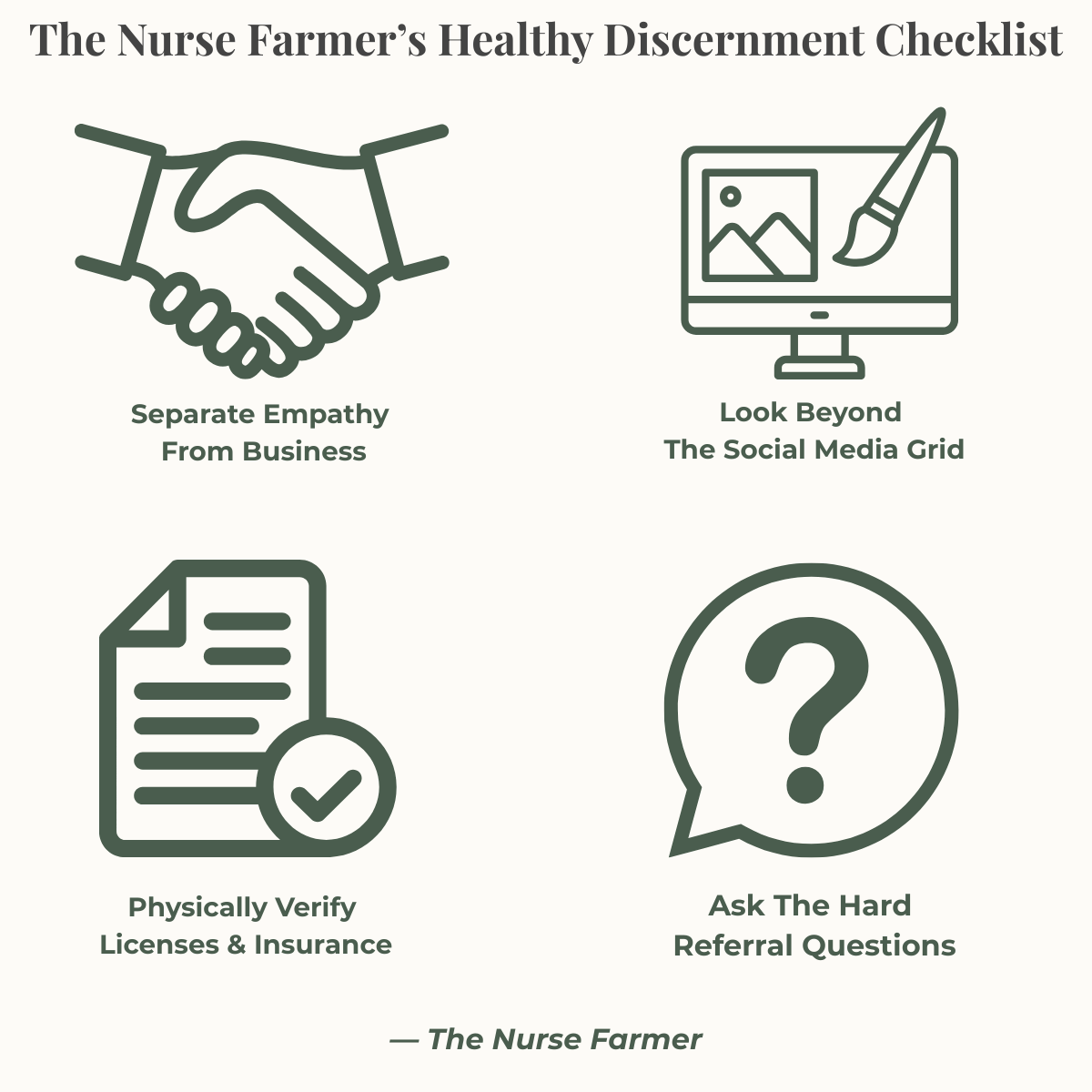
Managing our health and well-being as we age means protecting our peace of mind and our assets. To help you stay safe from digital and personal manipulation, here is my nurse-approved checklist for healthy discernment:
Separate Empathy from Business: It is wonderful to have a soft heart for someone's personal struggles, but a contract should be based strictly on credentials, verified quality, and references.
Look Beyond the Grid: Pretty pictures on Facebook or Instagram can be easily stolen or staged. Look for objective, unedited reviews on independent platforms like Google or the Better Business Bureau.
Verify the Paperwork: Never hire a contractor without physically verifying their active license, structural bonding, and liability insurance. A reputable professional will gladly hand these over.
Ask the Hard Questions: Don't just take an enthusiastic word-of-mouth recommendation at face value. Ask: How long have you known them? Have they personally done work for you? Are they related to you?
Keep doing good. Follow your beautiful, compassionate heart. But as you navigate this modern world, remember to pack your critical thinking alongside your garden tools. Be discerning, verify the facts, and never assume someone thinks the same way you do.
